
About Patricia & Tibetan Buddhism
What is Tibetan Buddhism?
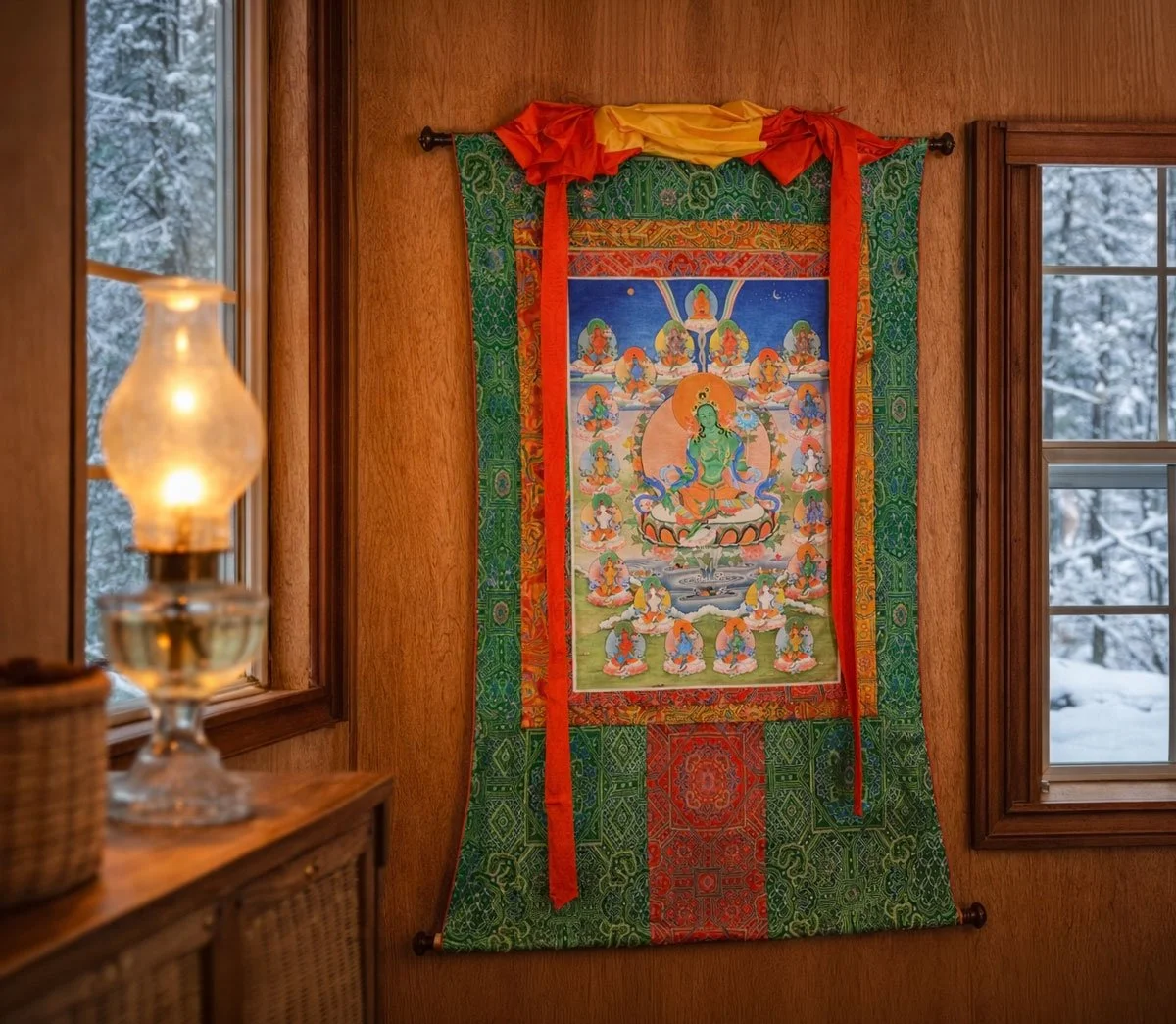
Tibetan Buddhism is a living contemplative tradition rooted in the Buddha’s teachings and shaped over centuries by the cultures of India and Tibet. It brings together meditation, ethical living, ritual, study, and compassion as a single integrated path. Rather than focusing on belief alone, it emphasises direct experience and inner transformation. The practices are designed to help us understand the nature of suffering, cultivate wisdom and kindness, and awaken to the interdependence of all life.
What distinguishes Tibetan Buddhism is its skilful use of many methods to meet the complexity of the human mind and heart. These include mindfulness and calm-abiding meditation, visualisation, mantra, ritual, and a close relationship between student and teacher. At its heart, the tradition is deeply practical and humane. Its purpose is not escape from the world, but learning how to live within it with clarity, compassion, and courage, meeting both joy and sorrow with an open and responsive heart.
About Patricia
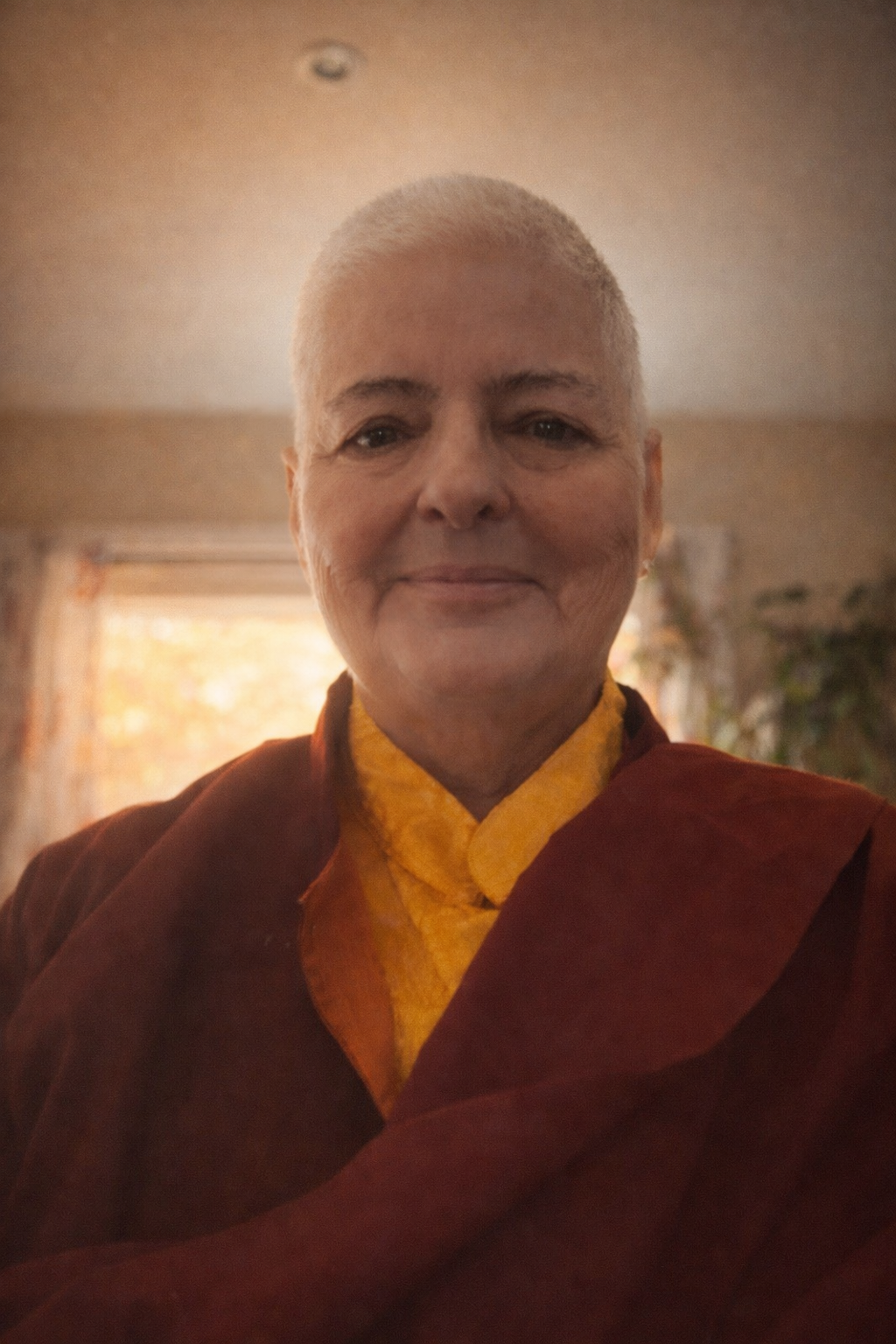
Patricia “Pat” Bush was born on May 5, 1955, in Cambridge (Galt), Ontario. Raised in a large, blended family, she developed an early love of story, ancestry, and belonging, interests that later grew into a deep engagement with genealogy and religious heritage. At age ten, her father introduced her to Theosophy and Greek mythology, opening an imaginative and spiritual landscape that shaped her lifelong interest in religion, symbolism, and the arts.
A mother and grandmother, Pat’s life bridges family life and contemplative practice. She holds a master’s degree in Religion and Culture from Wilfrid Laurier University, with a focus on ritual performance and feminist spirituality. Born into a Presbyterian family and later confirmed in the United Church of Canada, her Christian roots gradually unfolded into an interfaith contemplative path.
While at university, she began studying Buddhist meditation, first in the Korean Zen tradition with Venerable Samu Sunim at the Toronto Zen Buddhist Temple, and later within Tibetan Buddhism. She took refuge and bodhisattva vows with Khenpo Sonam Tobgyal Rinpoche and, in 1998, was ordained as a novice nun by His Holiness Penor Rinpoche, receiving the name Thubten Sonam Lhamo. She later trained at Gampo Abbey in Cape Breton and made pilgrimage to the Five Sacred Buddhist sites in India and Nepal.
Today, she continues her practice in the Dzogchen tradition under the guidance of James Low, integrating scholarship, lived experience, and compassionate practice through writing, teaching, and facilitation.
Spiritual Growth
A Spiritual Autobiography
Spiritual growth is rarely a straight line. It is shaped by questions, relationships, memory, and the courage to look honestly at where we come from. In this reflective autobiographical essay, Patricia explores the unfolding of her spiritual life through Christianity, Buddhism, and the deep family and cultural roots that formed her long before she ever named a spiritual path.
The story begins with a gentle but unsettling challenge from a close friend in India, an invitation to revisit the faith of her childhood while living as a Buddhist monastic. That single conversation opens into a much larger inquiry. What do we carry forward from our earliest beliefs? Can multiple traditions live together without contradiction? How do ancestry, family stories, and lived experience quietly shape the way we pray, practice, and understand compassion?
Drawing from personal memory, pilgrimage, family history, and decades of study and practice, this piece traces a lifelong dialogue between Christianity and Buddhism. It is a story of return as much as discovery, of honouring roots rather than abandoning them, and of allowing spiritual life to remain open, human, and unfinished.
Frequently Asked Questions
-
Anyone who is curious about their own mind and heart.
You don’t have to “become a Buddhist” to benefit from Buddhist teachings. Many people explore Buddhism simply because they want to understand suffering, reduce stress, or learn how to meditate. Others are drawn to its emphasis on compassion, interconnection, and practical wisdom in everyday life.
Buddhism can be especially helpful for those who:
feel overwhelmed by thoughts or emotions
seek tools for inner calm and clarity
want a spiritual path grounded in experience rather than belief
value compassion and service to others
appreciate contemplative practices like meditation, mindfulness, and ethical living
People from all religious backgrounds — or none at all — study and practice. Some remain rooted in their own faith traditions while integrating meditation and Buddhist insights. Others embrace Buddhism more fully as a lifelong path.
At its heart, Buddhism simply invites you to look directly at your own experience and discover what brings freedom, kindness, and peace.
If you have a mind and a heart, you already qualify.
-
Start small. Start simple. Start where you are.
You don’t need special beliefs, robes, or a new identity. Buddhism begins with paying attention to your own life.
Begin with meditation.
Sit quietly for a few minutes each day. Feel your breath. Notice your thoughts and emotions without trying to fix them. This simple practice of awareness is the foundation of everything else.Learn the basics.
Read an introductory book or listen to a few talks about core teachings such as mindfulness, compassion, impermanence, and the Four Noble Truths. Think of these not as doctrines to believe, but as lenses to look through.Practice kindness.
Buddhism isn’t only about the cushion. Try bringing a little more patience, honesty, and compassion into daily life. How you speak to the cashier or your family is just as important as formal meditation.Find community.
A local meditation group, class, or online sangha can offer guidance and encouragement. Practicing with others reminds us we’re not figuring this out alone.Take your time.
There’s no rush. Buddhism is less like a course to complete and more like a garden to tend. A few steady steps matter more than grand spiritual leaps.
In the end, learning Buddhism is very human: sit, breathe, notice, be kind, repeat.
That’s it. No incense required (though tea helps).
-
No, you don’t have to be a Buddhist to attend a meditation session or a workshop. You don’t have to be of any particular faith. All are welcome. Come with an open mind and any questions if you have them.
-
At the level of practice and transformation, they overlap beautifully. At the level of metaphysics and doctrine, they diverge. Buddhism: no creator God, no permanent self (annata), liberation through insight, cyclic rebirth. Christianity: personal/relational God, enduring soul/personhood, salvation through grace/ love, one life and resurrection. Christian writers and mystics like Thomas Merton or Julian of Norwich sound sometimes uncannily like Buddhist teachers.
-
The Gautama Buddha taught that there isn’t an eternal soul or fixed self ( this teaching is called anatta) that travels after death but there isn’t ”nothing either.” Instead there is a continuity of causes and conditions. Think: a flame passed from candle to candle, river flowing (same river, new water), echo moving through a valley. Karma (actions, intentions, habits of mind) conditions what unfolds next. So after death the pattern continues, not the person. There is the idea referred to as rebirth. Most traditional schools say that after death, consciousness or karmic momentum arises again in another form: human, animal, heavenly realms, hellish realms, or liberation (nirvana). But these are not punishments or rewards from a judge.They are more like:psychological states that your mind naturally grows into:
Anger → hellish experience
Greed → hungry ghost experience
Compassion → spacious, luminous states -
Buddhist teachings and guided meditation sessions are offered in the Muskoka region of Ontario, including Huntsville and surrounding communities.
Teachings focus on practical wisdom, compassion, mindfulness, and ethical living rather than abstract philosophy. Gatherings are intentionally small and grounded, often held in quiet, natural settings that support reflection and presence. Details for current teachings and workshops are shared on the website.
-
Shamatha, often translated as calm abiding meditation, is a foundational Buddhist practice that trains attention and steadiness of mind.
By gently returning to the breath or another simple focus, practitioners learn to notice thoughts and emotions without becoming overwhelmed by them. Over time, this builds emotional balance, clarity, and resilience. Many people turn to Shamatha meditation in Muskoka as a practical way to manage stress and reconnect with inner calm.
-
Monastics aren’t always teachers, but the ones who are sometimes share their knowledge of the Dharma at colleges called Shedras. A shedra is a traditional school for advanced study found in monasteries and nunneries. Sometimes monastics are asked by their teacher to share information and meditation instruction in a more informal situation within a community if people have shown an interest. This has been my experience.
-
I had been practicing meditation and attending teachings at a Korean Zen temple. While I appreciated my time there, I did not feel a strong connection to the resident teacher. In Buddhism, the relationship between teacher and student is essential for meaningful realization and growth.
During a Zen workshop, I had a vivid vision while meditating. When I spoke with the Sunim (teacher) about it, he explained that spontaneous visions and visualization are not encouraged in Zen practice. He suggested that I might benefit from working with a Vajrayana teacher who could better support my understanding of such experiences. Tibetan Buddhism, unlike Zen, recognizes visualization as an important part of the path.
Following this guidance, I visited a Tibetan Buddhist temple and felt an immediate connection with the Lama (teacher). In Tibetan Buddhism, trust, respect, and commitment between practitioner and mentor are central; this relationship forms the foundation upon which the spiritual path develops.
This relationship is formally established through a ceremony called Taking Refuge in the Lama and the Three Jewels (the Buddha, Dharma, and Sangha). During this ceremony, the student accepts vows to protect the relationship and receives a new name, symbolizing a deep and meaningful commitment. For me, taking these vows signified accepting refuge as a lifelong commitment.
The refuge prayer is repeated daily, reaffirming one’s dedication to the Buddha, Dharma, and Sangha, and renewing the vows with faith and trust.
-
Ordination is not required to follow the Buddhist path. Both monastics and lay practitioners commit to an ethical way of life, though monastics take on more vows and follow a stricter discipline, with particular emphasis on chastity and mindful conduct.
I decided to take these vows after a Dharma discussion in which one of the “four thoughts that turn the mind to Dharma” was discussed—the Buddha’s teaching on impermanence and death. We reflected on what we might do differently if we knew our time was limited. This question affected me deeply, as I had just learned that a friend had received a terminal diagnosis.
At that point in my life, it felt clear that committing more fully to the ethical path of monasticism would deepen my understanding of the Dharma and allow me to use the time I have more meaningfully. Another woman in the community was also considering ordination, so I asked her for guidance on learning more about the process. After speaking with my teacher, I decided to attend an ordination ceremony and formally receive the vows.
-
While I was in university (1985–1987), I studied feminist ceremonies and rituals within women’s communities that honored the sacred feminine. In 1991, I joined a women’s group and discovered that I deeply enjoyed creating rituals, drawing on what I had learned in my ritual studies courses during my MA program. My thesis supervisor, Dr. Ronald L. Grimes, is a well-known scholar and speaker in the field of ritual studies, and his work strongly influenced my approach.
Creating and celebrating rituals with other women around the full and new moon became a regular practice. Over time, I also created or joined mixed-gender groups interested in mythology and in gods and goddesses from cultures around the world and throughout history. Meditation was often an integral part of these gatherings.
As my experience grew, I was invited by university professors to give guest talks on goddess traditions and related topics in their classes. I was also asked to share my knowledge of ritual and ceremony in high school classes, church groups, and community workshops.
After I became a Buddhist and later a monastic, a teacher encouraged me to share Shamatha (calm-abiding) Buddhist meditation with those who expressed interest.
-
Yes. Calm Abiding, or Shamatha, meditation classes are offered in Muskoka and are open to both beginners and experienced practitioners. No prior experience is needed.
These weekly sessions introduce simple breath awareness and focus practices that help calm the mind, reduce stress, and build clarity. Chairs and cushions are available, and instruction is gentle and accessible. Many people attend simply to learn meditation in a supportive and welcoming setting.
-
Yes. Personalized wedding ceremonies are offered in Muskoka and are shaped collaboratively with each couple.
Rooted in Buddhist values of compassion, intention, and mutual respect, these ceremonies emphasize presence rather than rigid tradition. They are inclusive and open to couples of all backgrounds and beliefs. Often held outdoors among forests and lakes, the setting itself becomes part of the blessing.
-
No. Like A Moon On Water welcomes people from all faith backgrounds, as well as those who do not identify with a particular religion.
The teachings and reflections explore Buddhism alongside Christianity, interfaith dialogue, and everyday spiritual life. Many visitors are simply seeking thoughtful writing, meditation guidance, or meaningful ceremony in Muskoka. You are welcome exactly as you are.